When Breath Becomes Air Book Report
What makes life worth living in the face of death?
Daniel Zhang
5/9/20263 min read
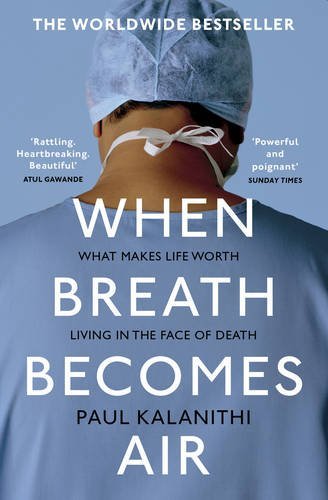
For Paul Kalanthini, being a doctor has always been both a morally and technically difficult task. Every day, he has to make decisions that not only change his fate but also others'. But when these decisions are taken away from his hands, and he becomes a patient himself, he struggles to live a life that, for most, would have been far easier.
In Paul Kalanthini’s posthumously published memoir, When Breath Becomes Air, Kalanthini records his days as a doctor and his experience battling stage IV metastatic lung cancer. Central to the story is his struggles to maintain his role as a healer while dealing with cancer. But even as he holds on to his job,
As a doctor, Kalanthini wasn’t only focused on the science of healing people, but also on the ethics. His role required him to make crucial choices with every patient, ones that could be the difference between life and death, a future of hope and happiness, or a future contorted with pain. He finds that to be a good doctor, decisions do not only depend on the science of medicine, but also on the beliefs and identity of the patient. He realizes that his role, specifically as a neurosurgeon, is working with “a manipulation of the substance of ourselves……the question is not simply whether to live or die but what kind of life is worth living.” He realizes that as a surgeon, his role is extremely complex, for not only is he a doctor, but also a consultant. He valued “the heroic spirit of responsibility amid blood and failure” the most as a doctor, for he had the power to change the lives of those who relied on him.
However, when he was diagnosed with lung cancer, his world changed. The power over fate was taken from his hands, as he too succumbed to the vulnerabilities of being human. As a patient, he realized that “severe illness wasn’t life-altering, it was life-shattering.” Facing the fact that he would die soon, he realized how much illness can affect a person, and understood the fear and desperation that came from the powerlessness. While he knew he would die both before and after he was diagnosed, he realized that “the problem wasn’t really a scientific one. The fact of death is unsettling.” Even as a doctor, he has struggled with the idea of cancer, even though he was familiar with matters of death, revealing the inner fragility of humanity.
Even as he becomes a patient, he hangs on to the role of a doctor. He continues to try to see things through science and rationality, persuading himself to accept the truth and understand how difficult the situation is. Even though he realizes that, as a patient, he depended on the doctor, he often went into health checks as if he were the doctor. He attempts to read his own scans, solve his own problems, and negotiate his situation as both patient and doctor. This takes an immense emotional toll on him, as his role as a doctor made him fundamentally different from normal patients. As a researcher himself, he realized that “[he] knew medicine better than most patients, and [he] knew its limits.” As he wrote himself, “I no longer knew who I was. Because I wasn’t working, I didn’t feel like myself, a neurosurgeon, a scientist, a young man, relatively speaking, with a bright future spread before him.”
But this excruciating middle ground offers profound insights into mortality and the value of living life. Through his experience as a doctor, he understands the impacts and limits of medicine better than any patient and can make his own decisions about his own dying life. But through his life as a patient, he reframes what doctors owe to their patients as he uses his own job to save his own life. But most importantly, he finds an experience that is truly human. Not just dependent on others for his own survival or making decisions for others for their life, but a combination of the two, where knowledge and ethics are balanced.
In conclusion, Paul Kalanthini’s memoir offers a powerful insight into life and death. When the situation is flipped, his experiences become deeply human, challenging ideas on life, death, knowledge, and emotions. In the end, Kalanithi did not die as a doctor or as a patient — he died as something rarer and more profound: a man who had seen mortality from both sides, and chose to illuminate it for the rest of us.